

It can be frustrating and worrying when your cat suddenly starts peeing outside the litter tray, especially if they have always been reliable with their toileting habits.
Many owners assume this is a behavioural problem, but cats rarely do this for no reason. Changes in litter tray habits can sometimes be linked to stress, pain, urinary problems, increased urination, or an underlying health condition.
Before assuming your cat is being difficult, it is important to rule out medical causes first.
Is my cat doing it on purpose?
No. Cats do not usually pee outside the litter tray out of spite.
If your cat has suddenly started urinating on the floor, bed, bath mat, laundry, couch, or other areas of the home, they may be trying to tell us that something is not quite right.
Some cats pee outside the tray because they are uncomfortable. Others may be producing more urine than usual, feel a sense of urgency, or have difficulty getting to or using their tray.
Possible causes include:
- Urinary tract disease
- Bladder inflammation
- Feline idiopathic cystitis
- Kidney disease
- Diabetes
- Hyperthyroidism
- Arthritis or pain
- Stress or anxiety
- Litter tray issues
As many of these causes can look very similar at home, a veterinary check-up is often the best way to work out what is really going on.
When is it an emergency?
Some urinary problems in cats can become serious very quickly.
If your cat is trying to urinate but cannot pass urine, this is an emergency, especially in male cats.
Please seek veterinary attention urgently if your cat is:
- Straining in the litter tray
- Crying or vocalising while trying to urinate
- Passing only small drops of urine
- Visiting the tray repeatedly
- Passing blood in the urine
- Lethargic, vomiting, or not eating
- Unable to pass urine at all
A blocked bladder can be life-threatening and should never be left to “wait and see”.
Is it peeing or spraying?
It can also help to understand whether your cat is peeing outside the tray or spraying.
Peeing outside the litter tray usually involves larger puddles on horizontal surfaces, such as the floor, bed, bath mat, couch, or laundry.
Spraying is usually a form of urine marking. It often involves smaller amounts of urine on vertical surfaces, such as walls, doors, furniture, or curtains.
Spraying is often linked to stress, territory concerns, other cats in the home, or outdoor cats nearby. However, medical causes should still be ruled out, especially if the behaviour is new.
Could stress or anxiety be involved?
Yes. Stress can play a big role in litter tray problems.
Cats are very sensitive to changes in their environment and routine. Even small changes can sometimes feel overwhelming to them.
Common stress triggers include:
- Moving house
- Renovations
- New pets
- New people in the home
- A new baby
- Visitors
- Conflict with other cats
- Outdoor cats near windows or doors
- Loud noises
- Changes in routine
- Lack of safe hiding spaces
Stress can also contribute to urinary conditions such as feline idiopathic cystitis, which causes inflammation of the bladder.
If stress is part of the problem, treatment often involves a combination of medical care, environmental changes and behaviour support.
Could the litter tray itself be the problem?
Cats can be very particular about where they toilet.
The best litter tray set-up is usually clean, non-fragranced, chemical-free and easy for your cat to access.
A few things to check at home:
- Do you have enough litter trays?
- Are the trays cleaned regularly?
- Is the litter strongly scented?
- Has the type of litter changed recently?
- Is the tray in a busy or noisy area?
- Is the tray too close to food and water bowls?
- Is the tray too small?
- Are the sides too high for an older or arthritic cat?
- Could another pet be blocking access?
As a general rule, we recommend one litter tray per cat, plus one extra.
For example, one cat should ideally have two trays. Two cats should ideally have three trays.
It is also best to avoid punishing your cat for accidents. This can increase stress and may make the problem worse.
Why senior cats are more at risk
Older cats are more likely to develop health problems that can affect toileting.
A senior cat may want to use the litter tray, but pain, stiffness, urgency, or increased urine production can make this difficult.
Senior cats may pee outside the litter tray because of:
- Arthritis or difficulty getting in and out of the tray
- Kidney disease
- Diabetes
- Hyperthyroidism
- High blood pressure
- Cognitive changes
- Pain or underlying illness
Cats are also very good at hiding pain and illness. Sometimes a change in litter tray behaviour is one of the first signs that something is wrong.
This is one of the reasons regular senior cat health checks are so important.
How vets investigate litter tray problems
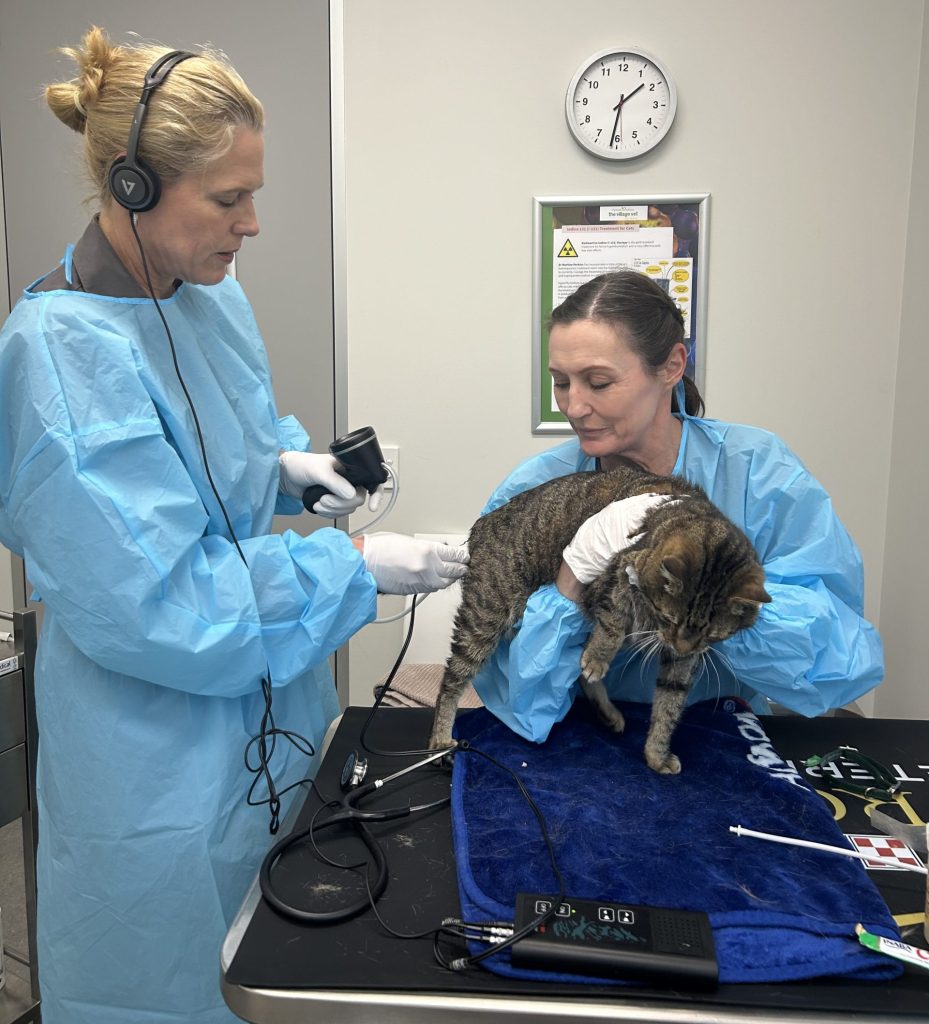
Because peeing outside the litter tray can have so many possible causes, diagnostic testing is often very helpful.
At The Village Vet, investigating litter tray changes may include:
- A thorough physical examination
- Urine testing
- Blood testing
- Blood pressure checks
- Pain and arthritis assessment
- Discussion about your cat’s home environment
- Imaging such as X-rays or ultrasound where needed
Urine testing can help us check for signs of infection, blood, crystals, inflammation, urine concentration changes and other abnormalities.
Blood testing can help assess overall health and screen for conditions such as kidney disease, diabetes, thyroid disease and other underlying illnesses.
The goal is to work out whether your cat’s toileting changes are medical, stress-related, environmental, or a combination of these.
Calm, cat-friendly care at The Village Vet

We understand that bringing a stressed or unwell cat to the vet can feel daunting.
At The Village Vet, our calm cat care approach is designed to make visits as gentle and low-stress as possible. Our team uses feline-friendly handling, calming pheromones and careful appointment planning to help cats feel more comfortable during their visit.
Our Killara clinic also has a dedicated cat consultation room, helping provide a quieter, calmer space for feline patients.
If your cat becomes very stressed in the carrier, car or clinic, please call our team before your appointment. We can talk you through ways to make the visit easier and, where appropriate, discuss additional support for anxious cats.
Concerned about your cat peeing outside the litter tray?
If your cat has suddenly started peeing outside the litter tray, visiting the tray more often, drinking more water, showing blood in the urine, or simply not seeming like themselves, it is worth arranging a veterinary check-up.
At The Village Vet, we can help rule out medical causes, assess pain and stress, and create a plan to help your cat feel more comfortable again.
Early assessment can make a big difference, especially if there is an underlying urinary, kidney, thyroid, diabetic or pain-related condition.